FUTURE SOIL
Couldn't load pickup availability
Hard clay shedding water?
Reduce sealing, improve infiltration, and move water into the active root zone.
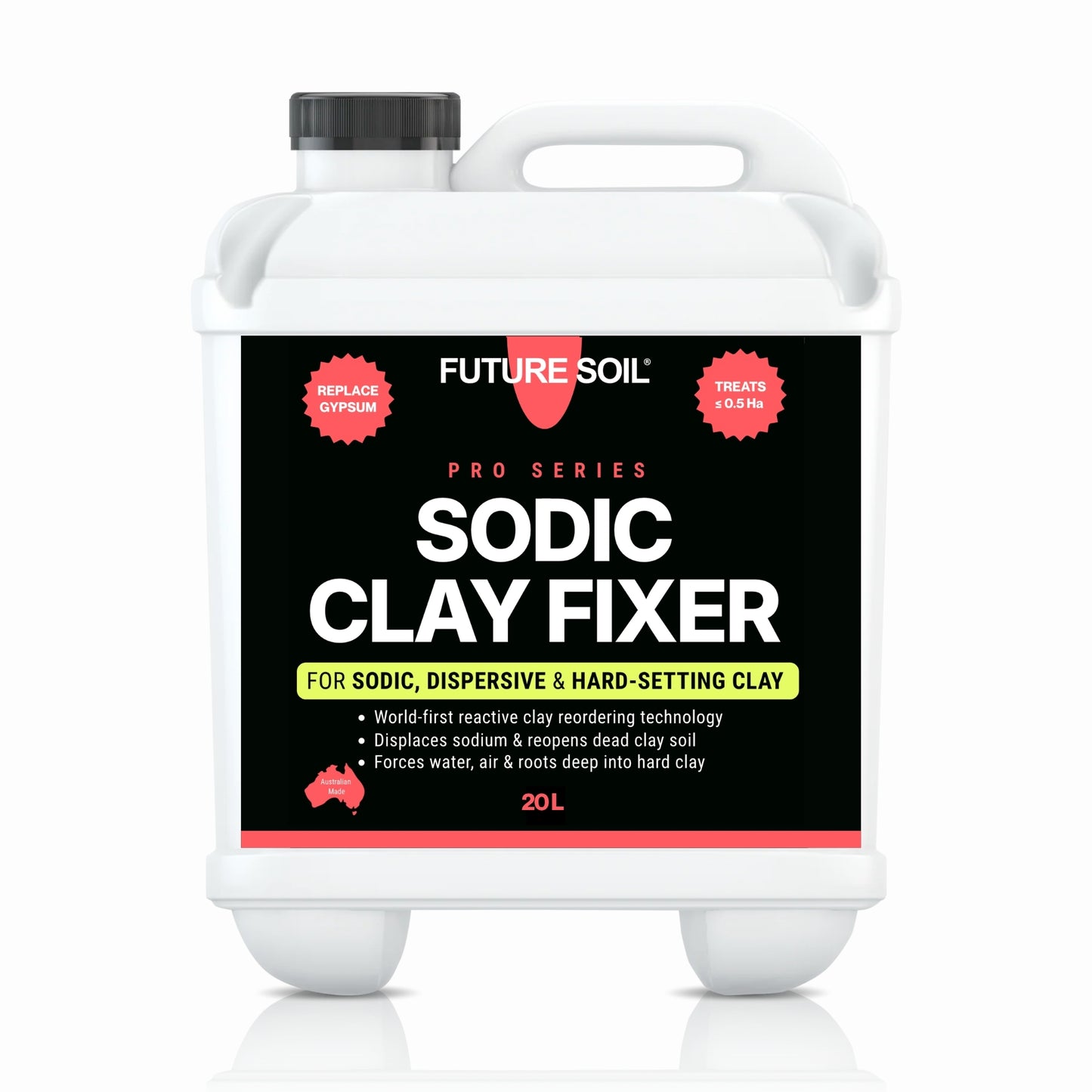
FUTURE SOIL® CLAY FIXER is engineered to fix heavy clay soils that stay wet, sticky, hard, cracked, muddy and difficult to grow in. This is a long term solution.
It changes how water moves through clay soil, allowing water to penetrate deeper and move more evenly through the profile instead of sitting on the surface or running away.
When water can move properly through clay again:
- roots grow deeper
- oxygen enters the soil
- nutrients move more effectively
- irrigation reaches the root zone
- less water is wasted
- less runoff and puddling occur
- soil becomes easier to work
- lawns and plants perform more consistently
FUTURE SOIL® CLAY FIXER:
- increases water penetration
- improves infiltration
- improves drainage
- increases moisture movement through the soil
- reduces runoff and puddling
- improves soil workability
- improves irrigation efficiency
- improves fertiliser performance
It is specifically designed for problem clay soils where excess sodium causes sealing, poor water movement and unstable soil structure.
FUTURE SOIL® CLAY FIXER modifies how clay holds water, nutrients and charge, supporting sodium flushing and better movement of calcium and moisture through the soil profile.
Suitable for lawns, gardens, turf, landscapes, trees, garden beds and larger soil areas.
Less runoff.
Better water movement.
Healthier, more functional clay soil.
Application Guide
Application Guide
Where To Use
Use on:
- reactive clay soils
- hard-setting clay
- sodic clay
- dispersive clay
- compacted clay
- sealed clay surfaces
Suitable for:
- gardens
- vegetable patches
- bare soil
- lawns
- turf
- gardens
- landscapes
- sports fields
- compacted construction fill
- poor-draining clay areas
When To Use
Apply when you notice:
- water pooling
- runoff
- sticky mud
- hard dry soil
- cracking clay
- patchy turf
- shallow rooting
- uneven irrigation
- poor drainage
Before Application
For best results:
- apply to moist soil
- pre-wet dry soil first
- avoid applying to dusty dry clay
- avoid heavy runoff conditions
Best results are achieved on:
- aerated soil
- opened soil
- recently worked soil
Standard Application Rate
5 mL per m²
- 500 mL per 100 m²
- 5 L per 1,000 m²
Use for:
- general clay improvement
- mild to moderate reactive clay
- lawns and gardens
Heavy Clay Application Rate
10 mL per m²
- 1 L per 100 m²
- 10 L per 1,000 m²
Use for:
- severe reactive clay
- hard-setting clay
- compacted clay
- severe runoff
- sodic or dispersive clay
Watering Can Application
Add: 45 mL into a 9 L watering can
Apply evenly across: approximately 9 m²
Wet the soil evenly without excessive runoff.
Hose-End Sprayer Application
- Set sprayer to low or minimum feed
- Walk slowly
- Wet the soil surface evenly
- Do not oversaturate
Boom Spray Application
- Dilute with water
- Apply evenly across the target area
- Apply enough water to wet the upper soil profile
Irrigation Application
Can be injected through:
- irrigation systems
- fertigation systems
Apply enough irrigation afterwards to move the product into the upper clay profile.
Avoid excessive runoff.
After Application
- Allow soil to dry naturally afterwards
- Avoid excessive traffic immediately after treatment
- Reapply if soil is heavily disturbed or compacted again
Reapplication
For severe clay: apply monthly until soil performance improves
Reapply:
- after aeration
- after renovation
- after digging
- after heavy traffic
- when clay symptoms return
FAQ's
FAQ's
Why does water sit on top of my clay soil?
Clay soils commonly seal at the surface, preventing water from entering properly. Instead of soaking in, water pools, runs off, and creates muddy surface conditions.
Common signs include:
- puddling
- runoff
- boggy lawns
- slippery clay
- patchy turf
FUTURE SOIL® CLAY FIXER is designed to improve water entry into reactive clay soils by helping keep the soil surface more open and functional.
Why is my clay soil sticky when wet and rock hard when dry?
This is one of the defining characteristics of reactive clay soil.
When wet, the soil collapses and becomes sticky and dense.
When dry, it contracts, hardens, and cracks.
This cycle causes:
- poor rooting
- difficult digging
- uneven irrigation
- weak turf performance
- surface sealing
FUTURE SOIL® CLAY FIXER is designed specifically for these reactive clay soil conditions.
Why does my lawn stay muddy for days after rain?
Heavy clay soils release water very slowly once saturated.
This often leads to:
- footprints remaining for days
- mower rutting
- soft ground
- stagnant water
- poor lawn performance
In many cases, the issue is not lack of drainage infrastructure, but poor infiltration into the clay profile itself.
Why does water run off my lawn instead of soaking in?
Because the clay surface has sealed.
Once sealed, irrigation and rainfall struggle to penetrate evenly. Water either pools or runs sideways instead of moving through the soil profile.
This can lead to:
- wasted irrigation
- dry patches beside wet patches
- shallow roots
- nutrient loss
FUTURE SOIL® CLAY FIXER is designed to improve infiltration and water movement through dense clay soils.
What are signs I have reactive clay soil?
Common symptoms include:
- water pooling
- runoff
- sticky mud
- hard-setting soil
- cracking in summer
- patchy turf
- moss from poor drainage
- shallow roots
- uneven irrigation
- wheel tracks holding water
- impossible digging when dry
These are all common signs of unstable reactive clay soils.
Can I use FUTURE SOIL® CLAY FIXER on lawns?
Yes.
FUTURE SOIL® CLAY FIXER is suitable for:
- residential lawns
- sports turf
- gardens
- landscapes
- compacted clay
- reactive fill soils
- sodic clay conditions
Especially where infiltration and drainage are poor.
How do I apply FUTURE SOIL® CLAY FIXER?
For best results:
- Apply to moist soil
- Pre-wet dry clay first
- Apply evenly across the area
- Allow the soil to dry afterwards
Application methods include:
- hose-end sprayers
- watering cans
- boom sprays
- irrigation systems
How much FUTURE SOIL® CLAY FIXER should I use?
Typical application rates:
Opened or worked soil
- 5 mL per m²
Compacted or severe reactive clay
- 10 mL per m²
Watering can guide:
- 45 mL into a 9 L watering can treats approximately 9 m²
How often should I apply FUTURE SOIL® CLAY FIXER?
For severe reactive clay:
- apply monthly during recovery stages
- reapply after renovation, digging, heavy traffic, or soil disturbance
Clay soils often collapse again when physically disturbed or compacted.
Why do clay lawns become patchy and inconsistent?
Because water movement through clay soil is often uneven.
This commonly causes:
- wet zones beside dry zones
- shallow rooting
- drowned areas
- stressed turf
- inconsistent colour and growth
Improving infiltration and movement through the clay profile helps improve irrigation consistency.
Why do fertilisers and irrigation underperform in clay soils?
Because the soil profile is not functioning properly.
When clay seals or compacts:
- water movement slows
- oxygen drops
- root access declines
- nutrients cannot move evenly
This often causes poor efficiency from otherwise good irrigation and fertiliser programmes.
Why is gypsum alone often not enough?
Gypsum can help supply calcium, but many clay soils still suffer from:
- sealing
- runoff
- hard-setting
- infiltration failure
especially where water movement through the soil profile is already poor.
This is why many people continue experiencing clay problems even after repeated gypsum applications.
Why do wetting agents struggle on clay soils?
Most wetting agents temporarily reduce water tension, but they do not address the instability of reactive clay itself.
Many clay soils quickly:
- reseal
- compact again
- return to runoff and pooling
FUTURE SOIL® CLAY FIXER is designed specifically for reactive clay soil behaviour and infiltration performance.
Why does my clay soil crack during summer?
Reactive clay expands when wet and contracts when dry
This movement can:
- damage roots
- harden the soil
- create uneven moisture zones
- reduce turf performance
Cracking is one of the most common signs of unstable clay soils.
Why do clay soils smell sour or stagnant after rain?
Because oxygen movement becomes restricted in saturated clay.
When clay remains waterlogged:
- oxygen levels drop
- biological activity changes
- roots struggle
Common signs include:
- sour smells
- slimy soil
- blackened wet areas
- weak turf growth
What makes FUTURE SOIL® CLAY FIXER different?
FUTURE SOIL® CLAY FIXER is designed specifically for:
- reactive clay soils
- infiltration improvement
- water movement
- sealing reduction
- hard-setting clay conditions
Rather than simply adding material or temporarily wetting the surface, it targets the underlying clay soil behaviour that causes ongoing performance problems.