How to Use Biochar and BIOCARBON in Soil
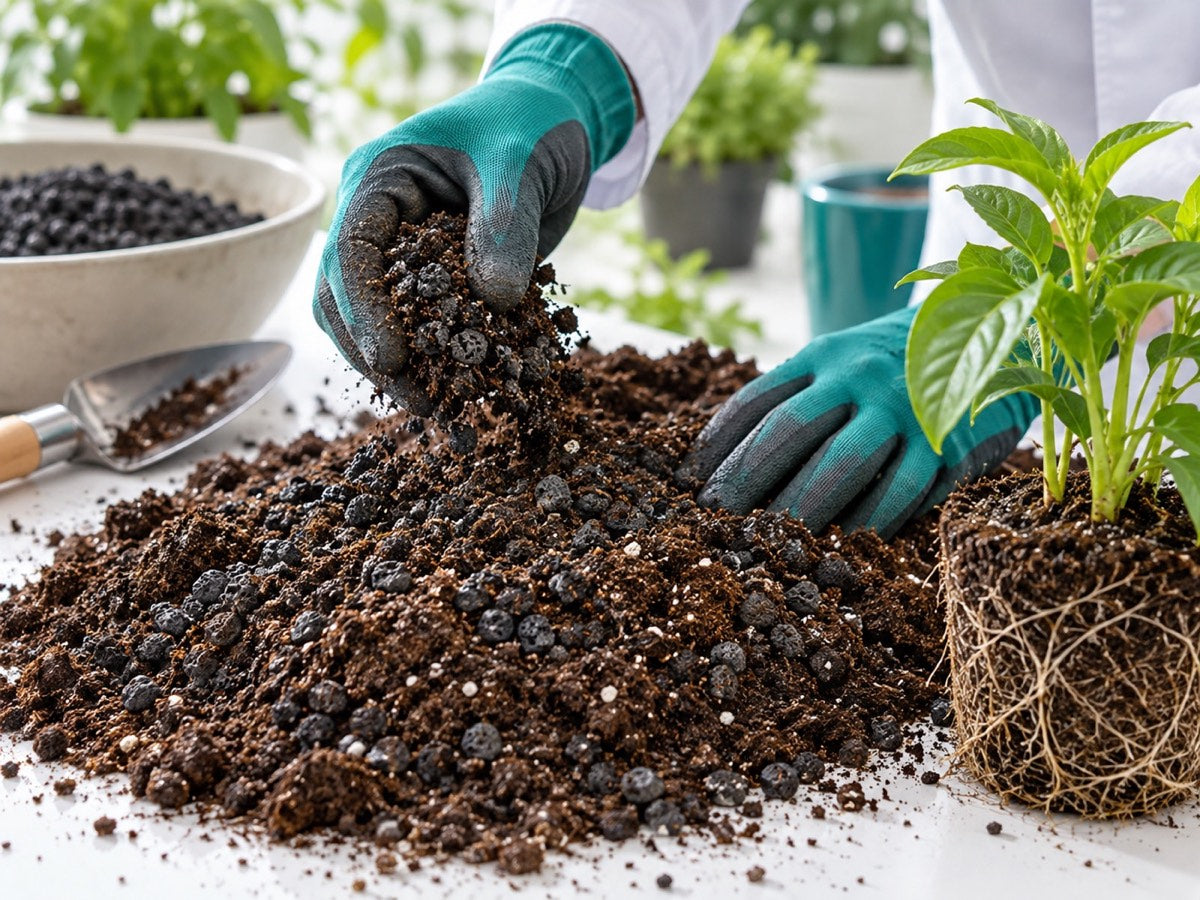
Biochar is a broad category of carbon-rich material produced from biomass under limited oxygen. FUTURE SOIL BIOCARBON is our solid biochar, selected and prepared for use in soil.
What biochar and BIOCARBON are for
Solid biochar is most useful when it can be mixed into soil or potting mix where roots will grow. Its porous carbon can help soil hold nutrients and water, provide places for microbes to live and add long-lasting carbon. Performance depends on the material, soil and application.
- new garden beds and landscape establishment
- turf root-zone construction and renovation
- horticultural and nursery growing media
- degraded or low-carbon soils
- agricultural soil-building programs
When to use solid BIOCARBON
Choose solid BIOCARBON before planting, during renovation or whenever you can mix it evenly through the intended depth of soil. Choose LIQUID BIOCHAR for established plants where applying a liquid is more practical.
Carbon does not fix every soil problem. Sodic or dispersive clay needs CLAY FIXER. Water-repellent or compacted soil that is not sodic may need POWER BREAKER to help water soak in. Freely draining sand may need SAND FIXER.
How to choose biochar
“Biochar” alone is not a specification. Ask how the material was produced, what it was made from, cleanliness, consistency, particle size, pH, salinity, ash and moisture. Match those properties to the crop, soil, water and application method.
How to apply BIOCARBON
- Check the soil first. Identify the problem you want to improve.
- Choose solid or liquid. Use solid BIOCARBON where you can mix it into the soil. Use LIQUID BIOCHAR where you need to apply carbon with water around established roots.
- Prepare as directed. Follow the current product specification and FUTURE SOIL program.
- Spread evenly. Avoid isolated bands, thick surface piles or concentrated planting-hole layers.
- Mix it into the soil. Blend it evenly through the depth where roots will grow.
- Water gently, then plant. Let the soil settle without washing fine material away.
- Check the results. Watch soil moisture, root growth, plant establishment and how the soil responds to feeding.
Why FUTURE SOIL BIOCARBON is different
Commodity biochar is often bought by colour or price even though material behaviour varies greatly. FUTURE SOIL starts with the soil problem and selects carbon to suit the job.
- Selected for soil improvement: treated as a functional soil input, not generic charcoal.
- Prepared for use: choose a form and particle size that you can apply evenly where needed.
- Part of your soil care: use alongside suitable watering, feeding and soil treatment.
- Format choice: solid BIOCARBON and LIQUID BIOCHAR offer different ways to add carbon to soil.
- Soil expertise: carbon needs are separated from sodicity, compaction, repellency and rapid drainage.
Common application mistakes
- assuming every biochar has the same properties
- using an arbitrary universal rate
- leaving dry material at the surface instead of incorporating it
- ignoring pH, salinity, drainage or existing nutrients
- expecting carbon alone to repair a different soil constraint
The practical reason to use it
Choosing suitable BIOCARBON and mixing it into the soil adds lasting carbon where roots will grow. Match the product and application method to your soil and the result you need.
View BIOCARBON · View Bulk BIOCARBON · Ask FUTURE SOIL for a site-specific program